
Pricing Guide for Movers in Austin

Austin moving quotes can feel oddly inconsistent. One company gives you a clean hourly rate, another sends a flat number, and a third adds random fees you didn’t even know existed.
This guide breaks down what’s behind those numbers before you book, from rate structures and line items to the local factors that shift a quote in either direction.
| In This Guide: A clearer look at Austin movers’ pricing can help you spot fair numbers, ask better questions, and avoid the kind of vague quote that turns moving day into math class with furniture. |
How Movers Price Their Work
 Most moving companies price based on the type of move and the level of service involved. A small local move, a full-service home move, and an interstate relocation all use different pricing logic. When comparing estimates, the first step is to match the type of pricing being used.
Hourly pricing for local moves
For local moves, many movers charge hourly rates. Pricing by the hour often includes the crew, truck, and basic moving equipment, but the finer details are important to review. Some movers charge for travel time, some have a two- or three-hour minimum, and some bill in 15-minute increments. Ask when the clock starts and stops, and what’s included in the rate.
In Austin, traffic can change the final number, too. A move from South Lamar to Round Rock may be straightforward on paper, then I-35 has other ideas.
Downtown loading docks, tight apartment garages, elevators, and long walks from truck to door can add real time to the move.
Flat-rate and binding estimates
Flat-rate pricing can work well when the mover has a clear inventory and full access details. This type of pricing has options.
- A binding estimate sets a price for the listed goods and services.
- A non-binding estimate gives an expected price, but the final cost depends on weight, services, and tariff rules.
- A binding-not-to-exceed estimate is often the most customer-friendly version when available. It caps the price for the listed scope, while allowing the total to drop if the actual work is lighter than expected.
The catch is scope, as a flat number built from a quick phone call can miss stairs, storage closets, garage items, or a piano hiding under a blanket. A virtual or in-home survey gives the estimate a much stronger foundation.
Weight-based pricing for long-distance moves
Long-distance moves out of Austin usually work differently than local jobs. Interstate pricing is commonly tied to shipment weight, mileage, packing, valuation coverage, access services, and delivery logistics.
Federal rules apply for these moves. Interstate movers should have a U.S. DOT number, and customers should receive written paperwork that explains estimate type, services, and rights.
Long-distance quotes are harder to compare because one may include packing, shuttle service, or storage, while another leaves those items out.
What Drives the Final Number on a Quote in Austin
What you’ll actually pay depends on the work the crew has to complete, not just the distance between homes. Home size, inventory, crew size, truck size, packing materials, stairs, elevators, long carries, disassembly, specialty items, and move date all affect price.
 Austin has its own quirks to be aware of. Downtown condos may require elevator reservations and certificates of insurance. Master-planned communities can have gates, parking rules, and long driveways. Rural properties outside the city may need extra truck planning.
None of these details are automatic deal-breakers, but they should be in the quote before moving day.
The Line Items Every Quote Should Show
A vague one-line quote makes trying to compare different companies difficult, and it also leaves too much room for surprises. Ask each mover to break down what’s included, what’s separate, and what could change the final bill. A clear quote should show:
Access charges should be listed as well, including:
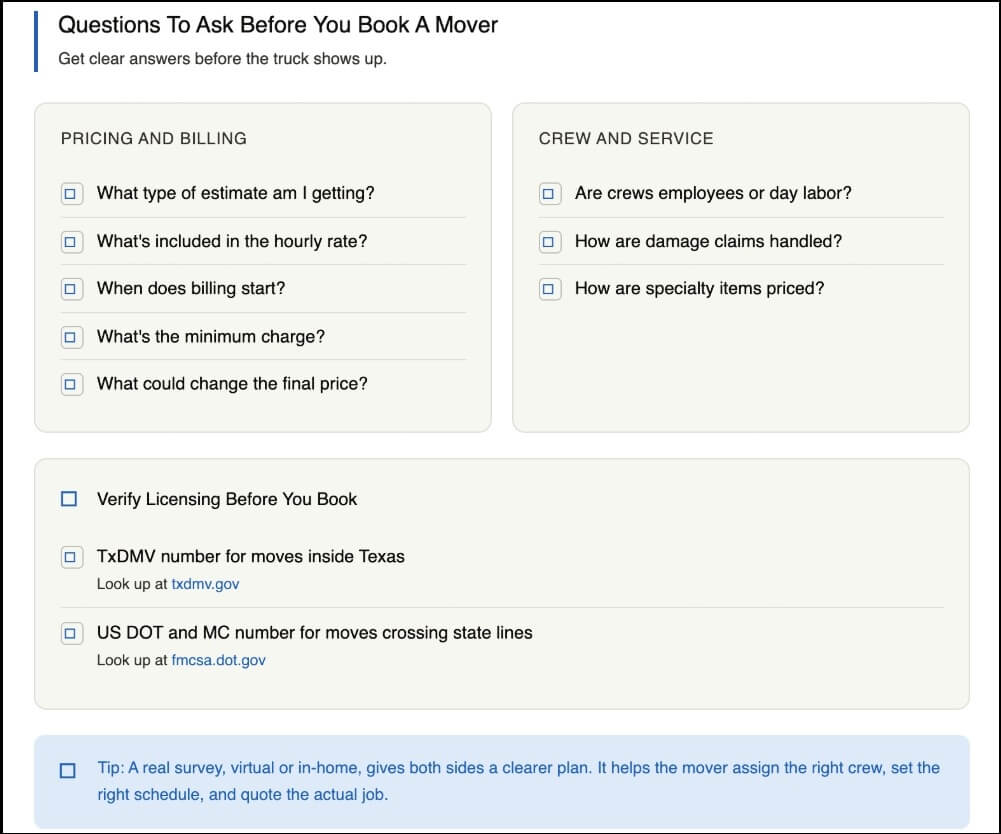
For Texas moves, check that the mover is licensed through TxDMV. According to the state, an “Active” certificate means the mover holds a license. For interstate moves, check the U.S. DOT number through FMCSA.
Factors that Push Pricing Up in Austin
Austin moving prices rise when demand rises or the job needs extra planning. Season, access, and specialty items often make the biggest difference.
Peak season and time of month
May, June, July, and August are commonly the busiest months for movers in Austin. Weekends, Fridays, and the end of the month are usually busier than midweek dates.
Flexibility can help. Tuesday and Wednesday can be less expensive options when schedules allow. Moving on a less popular date won’t erase the cost of labor, but it may improve availability and reduce pressure on the schedule.
Specialty and access costs
Pianos, safes, pool tables, large art, antiques, oversized sectionals, and gym equipment can require extra movers, equipment, or prep. Access costs can come from elevator windows, loading dock rules, long carries, stairs, parking permits, or shuttle service.
These charges aren’t automatically a bad sign. Hidden fees are the problem. A professional mover should ask about specialty items and access early, then document those details in the estimate.
How to Compare Austin Moving Quotes without Getting Burned
To figure out the cost of movers in Austin, the answer is in the details. The price only makes sense if the scope of work matches it.
Take the time to compare three or four quotes side by side, then check whether each one includes the same inventory, crew size, service level, travel time, materials, valuation, and access details.
Watch for warning signs: no written estimate, no license information, no survey for a meaningful move, a large upfront deposit, vague pricing, or a number far below the rest. A cheap estimate may become expensive when overlooked items are added on later.
Clear Quotes Make Better Moves in Austin
The best price is the one you understand. Austin moving costs depend on labor, access, timing, materials, estimate type, and scope. The lowest quote rarely stays the lowest once delays, damage claims, or surprise line items show up.
Olympia Moving and Storage in Austin can provide a free in-home or virtual estimate for residential moves through Move360 and commercial relocations through Scope360. Share your move date, both addresses, access details, packing needs, and any specialty items with our team so the quote accurately reflects the job at hand.